
TikTok Content Ideas Without Showing Your Face
Use no-face TikTok ideas that still give viewers proof to inspect: screen walkthroughs, hands-only demos, close-ups, slideshows, and repeatable series.
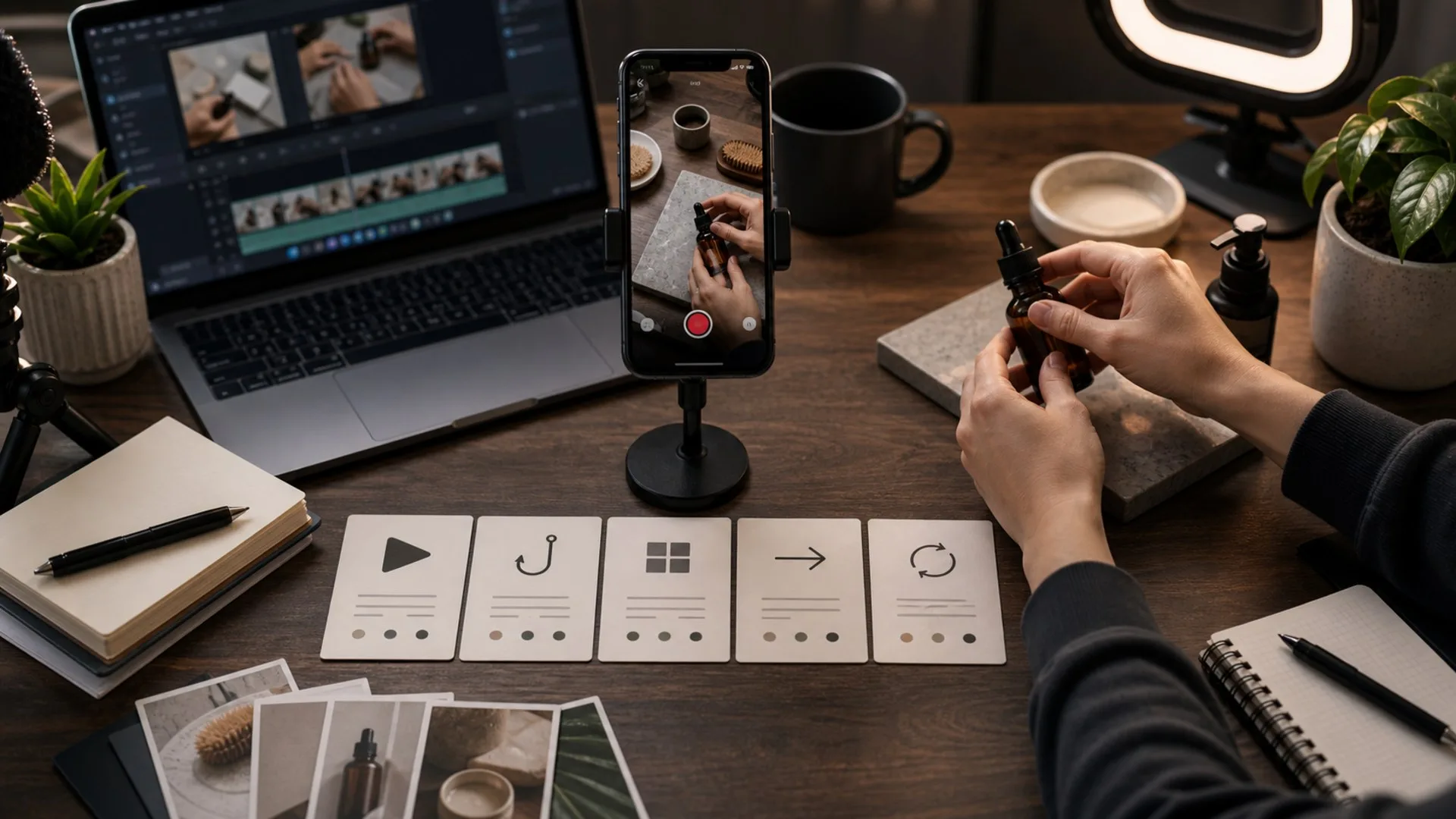
TikTok content can work without showing your face if each post gives the viewer something obvious to inspect, a clear reason to stop, and a format you can repeat. Not showing your face is a production choice, not a strategy by itself. The useful move is to pick the strongest proof surface you can show, then build the hook and series lane around it.
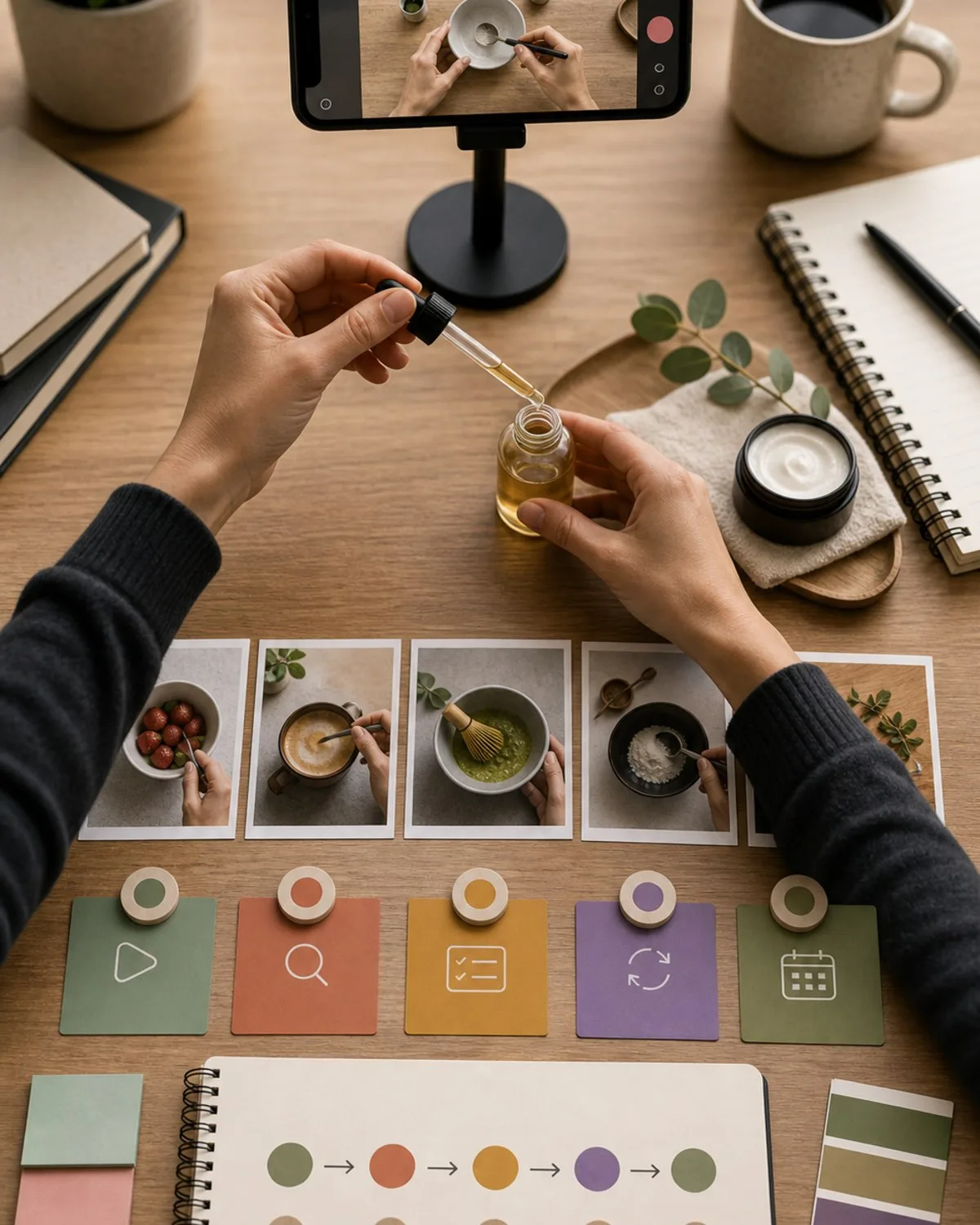
That matters for solo creators, social media managers, and small brands because most idea lists assume a talk-to-camera setup. That is not the only option. TikTok supports several native no-face lanes, including video, photo, text, Stitch, and Duet. What separates a useful format from filler is simple: the viewer can tell what to look at right away and why the next seconds are worth staying for.
Use a proof-surface framework before you pick ideas
The fastest way to choose TikTok content ideas without showing face is to start with the clearest proof surface you can show. A proof surface is the thing the viewer inspects instead of your face: a screen, a pair of hands, a product, a sequence of photos, a text claim, or a reused clip with commentary. Once that part is clear, the rest of the format gets easier to choose.
Pick the proof surface first
- What the viewer can inspect: a screen. Best matching format: walkthrough or audit. Best use case: tutorials, reviews, tool tips. Risk if done badly: tiny unreadable details.
- What the viewer can inspect: hands in motion. Best matching format: hands-only demo. Best use case: making, packing, cooking, fixing, setting up. Risk if done badly: shaky framing with no clear result.
- What the viewer can inspect: an object or product. Best matching format: close-up demo or comparison loop. Best use case: features, use cases, unboxing, before-after checks. Risk if done badly: pretty shots with no real claim.
- What the viewer can inspect: a text idea. Best matching format: text-led post or quick take. Best use case: opinions, myths, mini lessons, stories. Risk if done badly: too much text and no tension.
- What the viewer can inspect: a sequence of stills. Best matching format: photo slideshow. Best use case: steps, progress, comparisons, case snapshots. Risk if done badly: random photo pile with no order.
- What the viewer can inspect: someone else's clip plus your take. Best matching format: Stitch or Duet. Best use case: reaction, proof check, extension, counterpoint. Risk if done badly: borrowed attention with no added value.
Pick the clearest thing the viewer can inspect
Good no-face TikTok starts with a surface the viewer can decode in under two seconds. If the proof lives on a screen, use the screen. If the proof is tactile, show the hands. If the value is one sharp sentence, let the text carry the opening. If the format makes the viewer guess what matters, the missing face becomes a weakness instead of a neutral production choice.
Add one hook and one series promise
A proof surface is only the base layer. It still needs a hook that answers why this post matters now and a series promise that tells the viewer what kind of value will appear next time. Build ideas as surface + hook + repeatable lane, not as one-off clips that never teach the audience what to expect.
One topic, three no-face versions
- Topic: common product-page mistakes.
- Screen tutorial: open on one broken section, fix it, then show the cleaner result.
- Hands-only demo: place two packages side by side and show which details help a buyer decide faster.
- Text-led story: lead with "The problem was not the price. It was the missing proof." then unpack one lesson.
Examples and variations that work without a face
The goal here is not to collect every format TikTok allows. The goal is to pick one or two lanes that make your topic easier to show. Start with the format that removes the most friction from the proof you already have.
Screen recordings and walkthroughs
Screen recordings work best when the result is visible on the screen and the viewer wants the steps, not your reaction. This is a strong lane for audits, editor tips, research breakdowns, search phrasing fixes, and workflow shortcuts. The screen itself becomes the evidence. If you work in education, services, or analysis, this often pairs well with TikTok SEO clarity work because both depend on making the topic legible early.
Hands-only demos and process clips
Hands-only demos work because motion and sequence replace face-led delivery. They fit cooking, repairs, desk setups, packing, craft work, and any process where the result unfolds in order. Keep the framing stable, the background clean, and the payoff obvious. If the viewer can see how the thing moves from step one to step three, the post already has a reason to hold attention.
Product close-ups, unboxings, and comparison loops
Product close-ups are one of the easiest no-face lanes for small brands because the object can carry the proof. Use them for feature checks, use cases, what-changed clips, or simple comparisons. Keep the claim specific: what fits, what improved, what feels different, what solves a real objection. If you need the next step after attention to feel cleaner, the broader social commerce path helps frame what proof belongs near the buying decision.
Text-led story posts and quick takes
Text-led posts work when the sentence itself is strong enough to stop the scroll. This suits writers, consultants, niche commentators, and teams that can say something sharp before they can film something elaborate. One idea per post is enough. If the hook is vague, overloaded, or too long to scan on mobile, the whole format weakens fast.
Photo slideshows and before-after breakdowns
Photo slideshows are useful when the viewer needs comparison, order, or still detail more than live motion. They fit before-after examples, step flows, moodboards with lessons, product options, and small case snapshots. The key is sequence discipline: opener, proof, contrast, outcome, next step. Each frame should move the claim forward.
Voiceover with B-roll or ambient-sound clips
Voiceover plus B-roll works when the voice carries the logic and the footage gives context. Use it for short explainers, behind-the-scenes notes, mini reviews, or lessons where live demonstration would be clumsy. The visual layer still needs a job. If the images only decorate the script, the post feels generic fast.
Stitch and Duet commentary
Stitch and Duet are strong no-face options when your added layer is a real comment, correction, or extension. They work well for myth checks, reaction-led teaching, and response content built on a visible claim from another clip. The rule is simple: add judgment, not just agreement. If the audience does not get a clearer takeaway from your side of the post, reuse alone will not save it.
One product update, three different lanes
- Product close-up: show the old version, the new version, and the one change that matters most.
- Slideshow: turn the update into five still frames that move from problem to result.
- Voiceover: narrate what changed in plain language while the footage shows the object in use.
Why each variation works and where it breaks
No-face TikTok does not earn attention because it is anonymous. It earns attention because the format gives the viewer a clear watch reason. In practice, the repeat winners are step reveal, tactile motion, comparison, strong claim, sequence, and commentary tension. If none of those mechanics is present, the missing face is rarely the real issue.
Variation selection matrix
- Screen recording. Watch reason
step reveal. Best when: the proof lives on screen. Weak spot: tiny interface detail. First test: one fix with a clear end state.
- Hands-only demo. Watch reason
tactile motion. Best when: the process is physical. Weak spot: movement without payoff. First test: one short setup or repair.
The six watch reasons that replace face-led charisma
Step reveal keeps people waiting for the finished state. Tactile motion makes the process satisfying to follow. Comparison sharpens decision-making. A strong claim creates tension that demands context. Sequence helps the viewer predict where the post is going. Commentary tension makes the audience stay for your judgment. These are easier to decode than personality alone, which is why they work well in no-face formats.
Match the variation to the job, then note the failure mode
Pick the format by job first. Use screen recordings for clarity, hands-only demos for tactile proof, product close-ups for decision support, text posts for idea-first hooks, slideshows for ordered evidence, and Stitch or Duet for commentary. Then ask what will break the post fastest. Common failure modes are tiny unreadable details, a weak opening claim, no visible payoff, random format switching, or a lane that is too hard to repeat next week.
Reusable checklist for creators, managers, and small brands
No-face TikTok gets easier when the team runs the same short check before posting and the same short review after a small batch. The point is not perfection. The point is to stop guessing and learn which proof surface is easiest to show well.
Faceless TikTok Pre-Post Check
- Before posting: Is the proof surface obvious in the first two seconds?
- Before posting: Is the hook readable or audible fast on a phone screen?
- Before posting: Does the frame show one main thing clearly?
- Before posting: Does the post fit one repeatable series lane?
- Before posting: If the post promotes a product or service, is the music choice safe for that use?
- Before posting: If the post is text-heavy or photo-led, is it easy to scan and accessible?
- After 5 to 7 posts: Which proof surface produced the clearest comments or saves?
- After 5 to 7 posts: Which opening style made the topic easiest to understand?
- After 5 to 7 posts: Which format was easiest to make again without lowering quality?
- After 5 to 7 posts: Which lane should stay, improve, or drop?
Pre-post check
The best pre-post check is about decode speed and repeatability. Can a cold viewer tell what they are looking at right away? Is the text large enough to read? Does the clip belong to a lane you can make again next week? For small brands, add one policy-minded question: if the post promotes a product or service, check current commercial-music rules before you publish. For text-heavy and photo-led posts, captions and photo alt text are part of the quality bar.
Post-batch review after 5 to 7 posts
Review a small batch, not a single post. One clip can be noisy. Five to seven posts are usually enough to tell which proof surface felt clearest, which hook style kept creating useful comments, and which variation was easiest to repeat without forcing it. Keep the lane that is both understandable and sustainable. Drop the one that looked clever on paper but felt hard to execute.
Quick answers before you test your next format
FAQ
Can TikTok content work if I never show my face?
Yes. The post still needs clear proof, solid pacing, and a reason to keep watching, but the proof does not need to be your face.
What is the easiest no-face TikTok format to start with?
Start with the proof surface you already have. Use a screen recording for tutorials, a hands-only demo for physical process, or a text-led post for idea-first topics.
Are text posts and photo slideshows valid TikTok formats for this?
Yes. TikTok supports both, but each still needs a sharp claim or a clear sequence to avoid feeling like filler.
What is the best no-face format for a small brand?
Product close-ups, hands-only demos, and simple voiceover explainers are often the cleanest starting lanes because the object or result becomes the proof.
Should I use Stitch or Duet if I do not want to film myself?
Yes, if your added layer gives the viewer a real takeaway, correction, or extension. Reuse without a clear point feels thin quickly.
What is the biggest mistake with faceless TikTok?
Trying too many formats at once or posting a clip with no obvious proof surface, no payoff, or unreadable mobile detail.
Read next
Continue with adjacent articles that support the same public-viewing workflow.
guides
How to Become a Paid Content Creator on TikTok
Pick a paid creator path first, then build proof, workflow, policy checks, and a realistic next action instead of chasing random views.
guides
How to Create Content on TikTok and Get Paid
Create TikTok content around one revenue path, one recognizable lane, current eligibility checks, and a measurement plan that ties posts to payment signals.
news
Why Short-Form Video Will Dominate Social Media in 2025
See why short-form video keeps winning attention in 2025, how to audit reels, captions, comments, and profile context, and when one clip is not enough.