
TikTok Scripts That Convert: Analyzing High-Performing Video Structures
Map TikTok script patterns through hook phrasing, proof placement, objection turns, and CTA style without treating public performance as conversion proof.
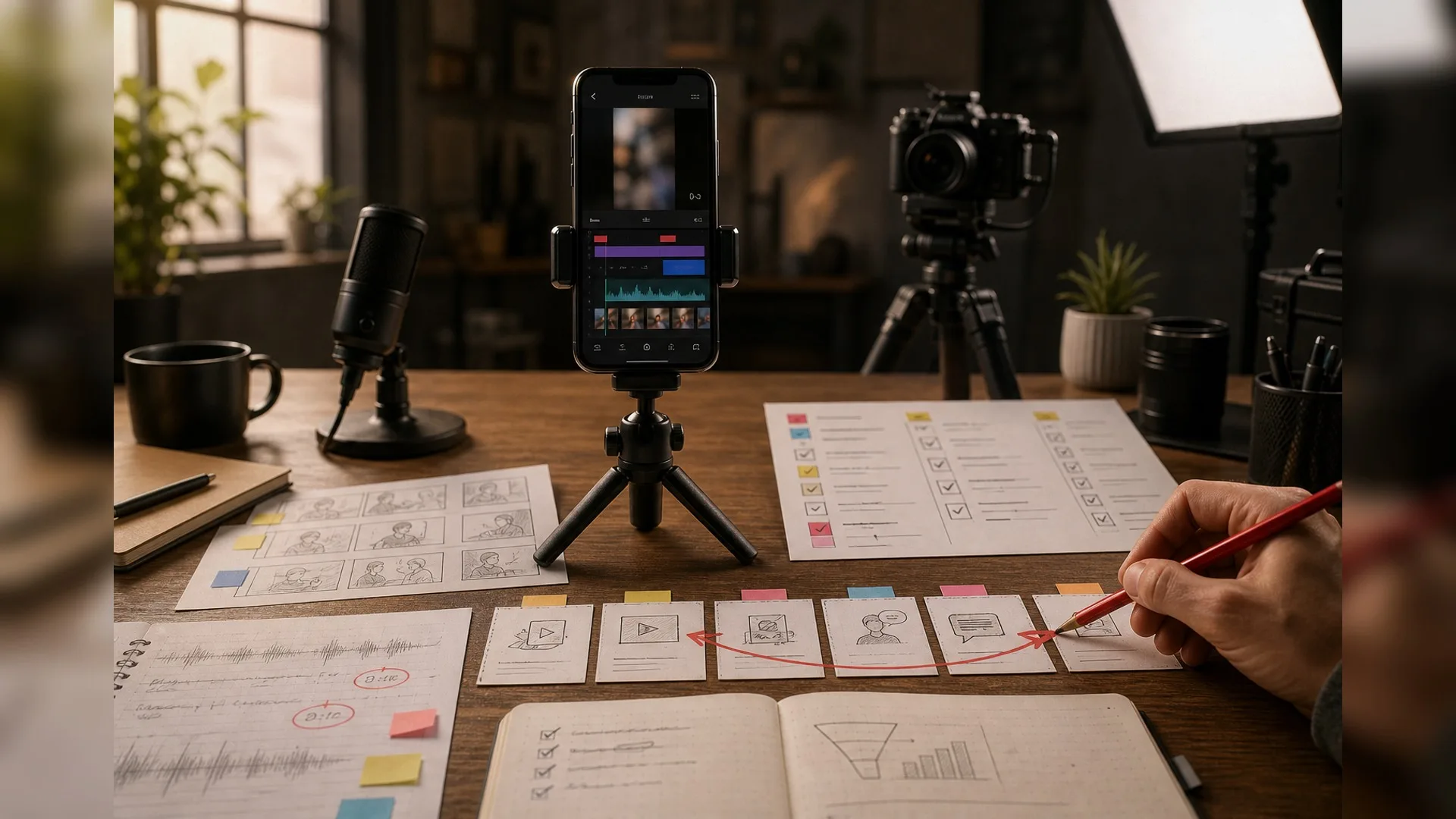
A visible-signal way to analyze TikTok scripts that appear conversion-oriented is to compare recurring patterns in visible posts: clear problem framing, early proof, and a narrow next step. You can study those patterns by reviewing hooks, on-screen text, demo placement, caption-topic match, and comment quality across several recent videos from the same account. The limit matters: public signals do not confirm exact conversions, algorithmic causes, or that the same structure will perform the same way for another account.
What counts as high-performing when you only have public evidence
For this kind of review, high-performing should mean relative, visible, and recent.
Relative means the post looks stronger than that account's usual baseline, not that it hit a universal benchmark. Visible means you can compare what is actually on the screen: the opening line, pacing, proof style, captions, comments, and whether the topic is repeated across several posts. Recent means you should look at a cluster of posts from the same period instead of comparing a clip from this week to one from a very different content phase.
A practical public definition is this: a script is worth studying when several recent posts on the same account get above-baseline visible response and use similar structural choices. That response might show up as more specific comments, more repeated topic framing, or a closer match between the promise in the hook and what people mention in the comments. It is still a clue, not proof of business results.
The structures that show up repeatedly
Different creators use different voices, but a few script shapes recur because they reduce confusion quickly.
- Problem to proof to payoff: open with a pain point, show the proof asset early, then explain the result or lesson.
- Mistake to correction: name the common error, show what it looks like, then give the cleaner version.
- Question to answer to example: start with one specific question, answer it plainly, then ground it in a short scenario.
- Claim to demonstration to caveat: lead with a strong statement, show the evidence, then add the condition or limit that keeps the claim honest.
- Objection to reframing to next step: surface resistance first, resolve it with a practical angle, then point to one low-friction action.
These structures recur because the clip type is easier to categorize from the public surface. You can compare whether the opening line, proof asset, and payoff all point to the same topic. For creators, that becomes a reusable pattern; for social managers, an audit lens; for small brands, a low-production format that keeps one offer or customer problem in view.
How to read the hook and first three scenes
The opening line matters most when it helps a stranger categorize the clip immediately. Good hooks usually do one of four jobs: name a problem, name a use case, challenge a bad assumption, or promise a visible comparison.
If a creator says, "Stop opening your videos with general intros," the viewer still needs more context. If the opening says, "Your skincare demo loses people before the product appears," the subject is easier to place. That kind of topic naming overlaps with the same teaching clarity behind EdTok-style lesson formats, where one clear question beats vague, clever phrasing.
After the hook, look at scene order. High-performing public examples often move like this:
- name the problem or promise
- show the object, screen, product, or result tied to that promise
- explain the point in one or two beats
- land on a narrow takeaway or action
When the first three scenes drift away from the original promise, the comment section often covers a wider mix of topics and the caption-topic match can look weaker. When the scenes stay aligned, comments more often reference the named problem, product, or example shown on screen.
Put proof earlier than most scripts do
One of the easiest ways to improve a script is to move proof forward. On TikTok, proof can be a demo shot, a before-and-after view, a screen recording, a physical result, a text overlay showing the exact example, or a comment that sets up the response. What matters is that the proof belongs close to the claim it supports.
If the hook promises a time-saving workflow, show the workflow or its result before a long backstory. If the hook promises a fix for a common mistake, show the broken version and corrected version before a broad explanation. Hypothetically, a small candle brand discussing packaging issues would usually benefit more from showing the damaged shipment first and explaining second than from opening with a generic founder monologue.
This is also why B2B short-video formats often need early proof: one clip can carry one idea well when the evidence appears early and the script does not make the viewer wait for the point.
Match the script to the goal, not just the topic
The same topic needs a different structure depending on what the clip is trying to do.
For audience-growth analysis, look for faster framing and broader entry language on the public surface. The subject is named quickly enough that a first-time viewer can place the clip without prior context.
For conversion-oriented analysis, look for more specificity and less spectacle on the public surface. In those clips, the product, offer, or process often appears earlier, and the CTA stays narrow. A soft CTA like "see the full checklist in the bio" or "compare this to your current version" keeps the next step closely matched to the example on screen instead of switching abruptly into a broad sales push.
For comment generation, the objection turn matters more. Start with the resistance point, show the trade-off, then invite a precise response. A hypothetical agency might ask, "Would you trust this ad creative without a product demo?" That creates a narrower discussion than asking people to share random opinions.
For series building, the script should be modular. Keep the opening format stable, change only the example or objection, and make the payoff timing predictable enough that viewers recognize the format across several posts.
Objection turns and payoff timing are often the hidden difference
Two videos can cover the same idea and still feel very different because of when they answer the viewer's likely objection.
In weaker scripts, the objection appears too late. The clip explains the concept, adds examples, and only then addresses the obvious hesitation. In stronger scripts, the objection arrives before the viewer leaves. That might mean opening with "This looks expensive, but here is the part people misjudge," or placing the main caveat directly after the first proof shot.
Payoff timing follows the same logic. If the script promises a transformation, the viewer should understand the nature of that transformation early, even if the full explanation comes later. If the script promises a lesson, the lesson should not be buried under filler setup. Publicly, you can compare this by checking whether comments reference the promised insight itself or ask what the clip was trying to say.
How to adapt a strong structure without copying it
The safe move is to borrow the logic, not the wording or surface style.
Keep the sequence that makes the video easy to follow, then swap in your own topic, proof asset, audience language, and objection. For example, if you notice a useful pattern that goes "problem, demo, caveat, CTA," you can reuse that order for a bakery, software tool, or creator education clip without copying the original phrasing, shots, or examples.
It also helps to compare whether the same topic remains clear when you repurpose it elsewhere. Compare another public channel to see whether the bio, pinned content, and recent posts preserve the same subject language and proof style. That does not prove cross-platform conversion. It does show whether the script idea survives outside one feed.
A simple review checklist for five recent posts
If you need a repeatable audit, review five recent posts from the same account and note the same fields each time:
- hook type
- first proof moment
- scene order
- payoff timestamp
- objection turn, if there is one
- CTA style
- caption-topic match
- comment specificity
Then mark which patterns repeat in the posts that look above the account's visible baseline. Do not look for a secret formula. Look for repeated clarity: the same kind of opening, the same proof placement, the same type of promise, and the same level of topic precision.
That is the practical way to analyze TikTok scripts that convert from public examples. You are not trying to decode hidden platform rules. You are trying to spot script decisions that make a video easier to understand, easier to trust, and easier to repeat without copying someone else's work.
Decision Rule
Use a script structure only when the hook, proof, objection turn, and next step all serve the same promise. If the hook could lead to five different videos, it is too vague to evaluate cleanly.
FAQ
What is the simplest TikTok script structure to test?
Start with hook, proof, objection, payoff, and next step. Keep each part tied to one promise.
Can public signals prove conversion?
No. They can show clarity, reaction quality, and repeated structure, but not conversion by themselves.
What should I compare between videos?
Compare opening specificity, proof placement, audience objections, and whether comments repeat the intended idea.
Read next
Continue with adjacent articles that support the same public-viewing workflow.
guides
Mastering the 3-Second Hook: How to Stop the TikTok Scroll and Boost Engagement
Review TikTok hooks through topic naming, first-scene order, early proof, and whether the opening promise matches the clip.
guides
The Batch Theory: Why Creating TikTok Content in Series Drives Algorithm Success
Turn TikTok batches into recognizable series through clear topic names, stable hook-to-proof-to-payoff structure, and visible pattern checks that do not treat batching as a reach hack.
guides
TikTok SEO for Gen Z Search: How Gen Z Finds Content
See TikTok SEO in practice through topic naming, profile keywords, recognizable content lanes, and clear limits on what public review can prove.