
The Rise of Virtual Travel Communities
See how virtual travel communities become legible through recurring destinations, highlights, collaborations, comments, and location choices.
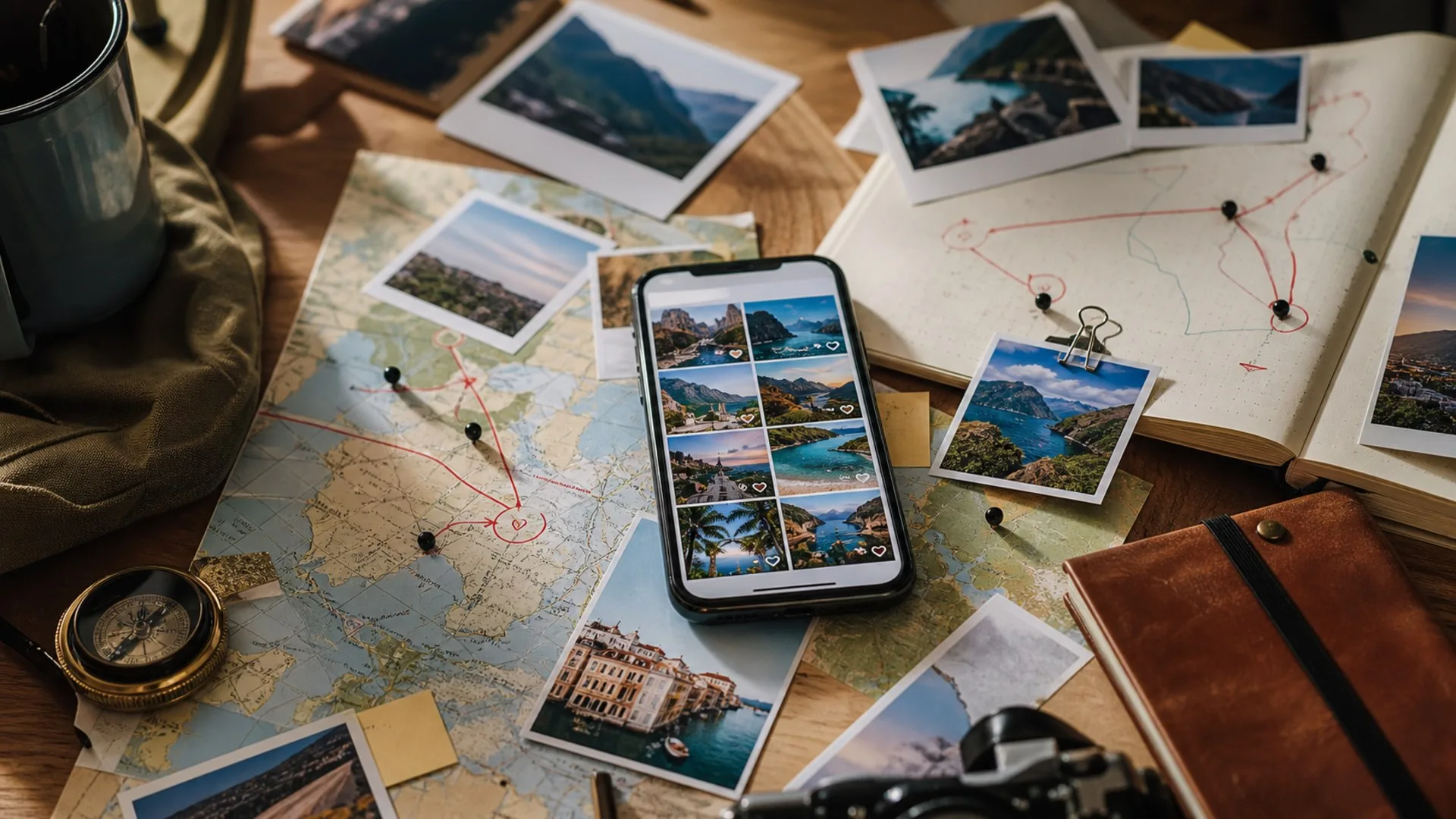
A virtual travel community is a recurring online travel cluster that becomes visible through repeated public patterns, not through one shared destination alone. The difference between a community and a coincidence appears when the same trip logic, saved references, recurring collaborators, and familiar questions keep showing up across several public surfaces. Public evidence can show that structure clearly enough to guide research, but it cannot prove private relationships, bookings, loyalty, or future behavior.
What a virtual travel community is, and what it is not
Tourism research now treats online travel communities as more than loose conversation spaces. A 2025 Journal of Travel Research study described them as platforms where distinct user groups interact and co-create value. In practical terms, that means a visible travel community is built through repeated participation around a recognizable travel lane: the same route logic, the same kind of planning detail, the same shared references, and the same back-and-forth discussion showing up often enough that strangers can read the pattern.
That is different from a general travel niche. It is also different from a momentary burst of attention around one city, one island, or one rail route. The useful rule is simple: if the overlap does not repeat across more than one public surface, it has not cleared the community threshold yet.
Coincidence vs community
Coincidence
several accounts post the same city during the same month, but their travel style, saved references, collaborators, and comment themes point in unrelated directions.
Community
several accounts keep returning to the same low-cost rail corridors, packing logic, overnight stop format, and practical route questions across profiles, posts, and public discussion.
Community vs coincidence
A community needs repeated structure. A 2024 Journal of Hospitality and Tourism Research paper on online travel communities found that question and reply ties showed reciprocity, multiple connectivity, and homophily. Translated into plain language, real communities tend to produce repeated back-and-forth between people who keep finding each other relevant, not just one shared scenic backdrop.
That matters because viral destinations create noise. Ten creators can post the same lake or old town in the same week without sharing a meaningful community at all. What deserves attention is repetition in the travel logic: similar budget bands, route types, timing choices, public references, and recurring questions that keep pulling the same kinds of people together.
Community vs virtual tourism
Virtual tourism is adjacent, but it is not the same topic. EHL's 2025 explainer defines virtual tourism as using digital technologies to explore destinations without physically traveling, from 360-degree tours to immersive VR environments. A virtual travel community, by contrast, is about repeated human connection and shared travel patterns that become visible around public content.
That distinction matters because mixed search results can blur the terms. This article is not about remote tours, digital museum visits, or VR destination previews. It is about how recurring public travel signals form a readable cluster around real travelers, creators, and small brands.
Why virtual travel communities feel more visible now
The rise in virtual travel communities is partly about behavior and partly about legibility. Expedia Group wrote in its 2025 Traveler Value Index highlights that more than 60% of consumers cited social media as a source of travel inspiration, up from 35% in its 2023 survey. Phocuswright's 2024 travel research update also said 57% of travelers use social media for trip purposes. That does not prove every travel niche became a true community. It does show that peer-led travel content now enters planning early enough to make repeated patterns easier to notice.
If you want the broader planning shift behind that change, this companion breakdown on how public travel content moved earlier in the trip path covers the larger discovery context. The narrower point here is simpler: communities feel more visible when the same travel lane stays on display long enough for comparison.
Why visibility rose
- Earlier peer-led discovery made it easier to inspect which destinations, formats, and advice loops keep recurring.
- Longer-lived public archives made it easier to inspect whether a pattern lasts beyond one trend cycle.
- Repeated collaborations and visible discussions made it easier to inspect whether the same names and questions keep resurfacing.
Discovery moved closer to peer content
The visibility story is not new, but the scale is. Brand USA's 2015 research note is old, yet still useful as historical framing because it recorded why travelers leaned on social content in the first place: they called it fresh, candid, and less filtered than official destination material. The trust logic matters because communities become readable only when people keep returning to public material that feels grounded in lived experience.
Freshness alone is not enough. Plenty of travel content is timely and still too scattered to form a community. What changed is that peer content now often shapes the first research pass instead of sitting at the edge of it. Once that happens, repeated routes, recurring questions, and familiar collaborators stop looking like random color and start looking like a real lane.
Public archives make patterns easier to read
The second shift is persistence. Profiles, pinned collections, saved route notes, recurring itinerary posts, and public comment threads make travel patterns easier to compare over time than fleeting posts ever could. A cluster becomes legible when the same signals keep surviving the first impression.
That is why the "rise" should be framed as improved visibility, not as automatic proof of deeper community in every niche. Better archives do not create a community by themselves. They simply make it easier to see whether repeated participation is actually there.
How to tell a real travel cluster from a one-off destination wave
A real travel community usually shows three kinds of overlap: identity cues, recurrence cues, and interaction cues. One layer alone can still be noise. The safer rule is to wait until at least two of those layers repeat across more than one public surface before calling the pattern a community.
Cluster test
- identity cues repeat the same public travel promise
- recurrence cues repeat the same travel logic over time
- interaction cues repeat the same names, questions, or collaboration overlap
- at least two layers appear across more than one public surface

Identity cues
Identity cues show what kind of travel lane an account publicly claims to represent. That can appear through a bio promise, a pinned route explainer, a recurring planning angle, or a steady answer to the question "why follow this account instead of another one?" These are the easiest signals to spot first because they sit close to the account's own framing.
They are also easy to overread. A clean bio and a neat set of pinned references do not prove a community on their own. They only tell you whether the account keeps naming the same lane clearly enough that other people could gather around it.
Recurrence cues
Recurrence cues show whether the travel logic repeats instead of drifting. Look for repeated regions, route types, activity styles, budget bands, trip lengths, or destination classes. Communities do not need to revisit one exact place forever. They do need to keep returning to the same kind of trip.
This is where many false positives fall apart. Several accounts can share an aesthetic and still have nothing meaningful in common. Repetition matters because it shows commitment to a lane, not just attraction to one photogenic stop. A coastal ferry circuit, food-first rail weekend, or family-friendly short-break format is more informative than one pretty square or one famous beach.
Interaction cues
Interaction cues move a cluster from content similarity toward community behavior. The strongest signs are repeated public questions, recurring names in discussion, visible collaboration overlap, and the same practical references surfacing again and again. That is where the 2024 interaction study becomes useful: structured back-and-forth is stronger evidence than one loud post with temporary attention.
Interaction cues still need restraint. One busy thread can be a spike, and one collaboration can be opportunistic. What counts is repetition. If the same people keep asking similar route questions, the same collaborators keep appearing, and the same references keep returning across several posts, the cluster starts to look durable.
A responsible review workflow for creators and small brands
The fastest responsible workflow is to scan one account deeply, widen to nearby accounts carefully, and log only the overlap that another reviewer could verify from the same public surfaces. That keeps the process useful for teams and defensible when someone asks how the conclusion was reached.
If your team wants a faster starting point for public profile research, the features hub is the cleanest place to compare workflow options before you widen the scan. The important part is not the tool choice. It is the discipline of writing down only what the public record actually shows.
Pass 1: define the public promise
Start by writing the account's public travel promise in one sentence. What kind of trip does the profile keep offering? Budget rail weekends, child-friendly coastal breaks, visa-light city hopping, design-heavy stays, food-led neighborhoods, or something else? Without that baseline, later overlap will look random.
Be literal. Use the bio, pinned references, recurring captions, and the account's own visible framing. Do not jump straight to assumptions about audience status, spending power, or intent. The first pass is about the lane the account publicly claims, not the motives you imagine behind it.
Pass 2: widen to nearby accounts
Next, widen only to nearby accounts that plausibly share the same lane. Similarity should be specific. "They all travel" is useless. "They all document low-friction rail itineraries through second-tier coastal cities with repeat packing and transit advice" is specific enough to test.
This step filters out accidental overlap. A comparison set that is too broad will manufacture fake communities everywhere. A narrow set helps you see whether the same route logic really repeats across several public accounts or only looked convincing in one isolated profile.
Pass 3: log interaction and repetition
Only after the lane is clear should you log repeated destinations, trip formats, question patterns, collaborators, and public references. The notes should be plain enough that another reviewer could repeat the check and get roughly the same answer. If the pattern cannot survive that test, it is still too speculative.
The result is not a courtroom verdict. It is a cluster hypothesis with better evidence. That is enough for editorial planning, creator research, and early partnership screening. It is also enough to stop weaker ideas early instead of forcing every travel trend into a community story.
What public evidence can support, and what it cannot prove
Public evidence is strong at showing repeated structure and weak at proving hidden outcomes. That line needs to stay hard. The closer a claim gets to motives, loyalty, private coordination, or bookings, the weaker the public proof becomes.
Evidence boundary
- Public evidence can support repeated route style across several accounts; it cannot prove loyalty, friendship, or private affiliation.
- Public evidence can support a recurring destination class or budget lane; it cannot prove bookings, revenue, or conversion.
- Public evidence can support stable overlap in collaborators or references; it cannot prove offline coordination or hidden strategy.
- Public evidence can support repeated public questions and concerns; it cannot prove audience demographics or motives.
- Public evidence can support a visible cluster worth researching further; it cannot prove future behavior or guaranteed results.
That boundary protects the article from the most common mistake in this topic: treating legibility as certainty. A cluster can be real and still leave major questions unanswered. Public patterns can show that several accounts operate in the same lane. They cannot tell you why each person joined, what they bought, how committed they are, or what they will do next.
How creators and small brands can use the insight
The practical value of spotting a virtual travel community is not vanity. It is faster decision-making. A visible cluster helps creators, managers, and small brands narrow partnership research, test whether a destination angle already has a coherent public lane, and decide which questions a campaign brief should answer before production starts.
Three uses matter most. Partnership screening gets sharper because you can tell whether a creator sits inside a repeat travel lane or just touched one trend once. Editorial planning gets cleaner because you can see whether the same route questions, budget concerns, or place types keep drawing attention. Destination-angle validation gets cheaper because you can check whether the public conversation is organized enough to support a focused story rather than a generic mood post.
The limit stays the same. Use the pattern to ask better questions, narrow your shortlist, and frame a more precise brief. Do not use it to claim certainty about outcomes.
FAQ
Is a virtual travel community the same as virtual tourism?
No. Virtual tourism is about exploring destinations through digital experiences without physically traveling there. A virtual travel community is about repeated human connection and shared travel patterns that become visible around public content.
Can one viral destination prove a travel community exists?
No. One shared place can be coincidence. A stronger claim needs repeated overlap in travel logic, public references, and discussion across more than one surface.
Can public travel content prove bookings or loyalty?
No. Public evidence can support a structure claim, such as a repeated route style or cluster of shared questions. It cannot prove motives, purchases, private ties, or future behavior.
Why do these communities feel more important now?
Peer-led discovery happens earlier in trip planning, and public archives stay visible long enough to compare. That makes recurring clusters easier to inspect. It does not mean every travel niche automatically became a true community.
Read next
Continue with adjacent articles that support the same public-viewing workflow.
tips
Creating Authentic Travel Content in an Over-Filtered World
Learn which public-facing cues make travel content feel grounded, how far editing and geotags should go, and how to review a post like an outsider before publishing.
guides
How Travel Creators Are Changing the Way We Explore the World
See how travel creators shape destination discovery through bios, repeatable post patterns, captions, highlights, geotags, and a quick usefulness audit.
discoveries
The Impact of Geotagging on Hidden Travel Destinations
Geotag hidden destinations with one practical test: how easily a stranger could copy the visit from the post, caption, and profile context.