
How Social Media Changed the Way We Travel Forever
See how public bios, recent posts, stories, highlights, captions, and location choices now shape destination discovery and trip expectations, with clear limits on what public content can confirm.
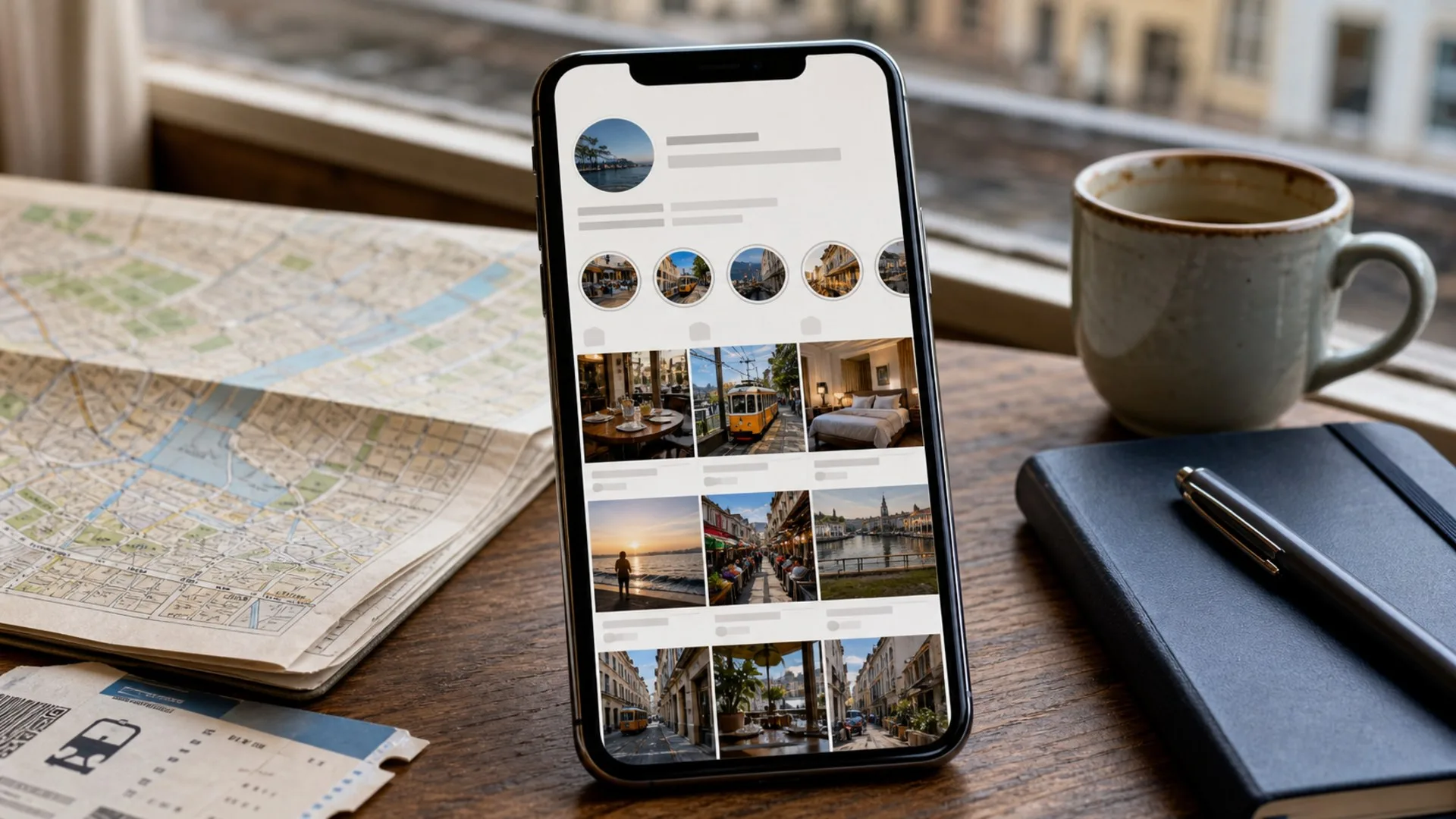
Social media changed travel by turning public content into a planning layer. A trip now often starts with a profile, a saved story row, a few captions, and a pattern of location choices before booking. The same public surface now does two jobs at once: it inspires the trip and scripts how the trip should feel. Expedia Group wrote in September 2023 that three-fourths of travelers use search engines, meta travel sites, and social media during the research phase. That does not mean public travel content can finish the job. It can make pace, transit burden, and trip style legible. It still cannot prove safety, accessibility, sponsorship, crowd conditions, or whether the route fits your version of the trip. Treat social travel content as a first filter, not a finished brief.
Travel discovery now starts with a public travel surface
The first permanent change is not just that more people share trips online. It is that travelers now pre-sort destinations through public surfaces before deeper planning begins. A profile can tell you whether the account keeps returning to ferry crossings, quiet neighborhoods, design hotels, market mornings, family stops, or late-night food runs. In one pass, a traveler can infer whether a place looks easy or demanding, polished or messy, expensive, crowded, or calm.
That is a different kind of discovery from the old brochure model. The destination is still the subject, but framing arrives earlier. A concise bio can promise slow travel or fast city breaks. Recent posts can imply whether the account favors route detail or pure atmosphere. Saved story collections can show whether the creator archives transport tips, room scale, weather shifts, or only the prettiest moments. Even a vague district label versus an exact venue tag changes how actionable the trip feels.
The practical effect is that people now compare not only places, but the way places are made readable in public. A strong travel surface reduces uncertainty before a traveler has checked opening hours, train frequency, or whether the place even matches the budget. A weak one may still be beautiful, but it leaves the viewer guessing. That is why discovery now starts with legibility as much as inspiration.
What research actually confirms about planning and decisions
The evidence base supports a stronger claim than "people get ideas online." Phocuswright reported in June 2024 that 57% of travelers use social media for trip purposes, including ideas, information, shopping, booking, or sharing. In the same research update, Phocuswright said 62% of social users made a specific trip decision after viewing travel content. Expedia Group's 2023 path-to-purchase work adds the broader planning frame: during the research phase, travelers use search, meta travel sites, and social media together rather than relying on one source.
Those figures do not prove that social media replaces search or booking research. They do show that public travel content sits inside the decision path, not outside it. A 2025 study in Humanities and Social Sciences Communications strengthens that point from another angle. After analyzing more than 22 million check-ins from 112,000 users, the authors found that social influence in travel behavior was measurable and stronger at shorter distances than at very long ones. The right takeaway is directional, not absolute: social content shapes planning often enough that it deserves to be read critically.
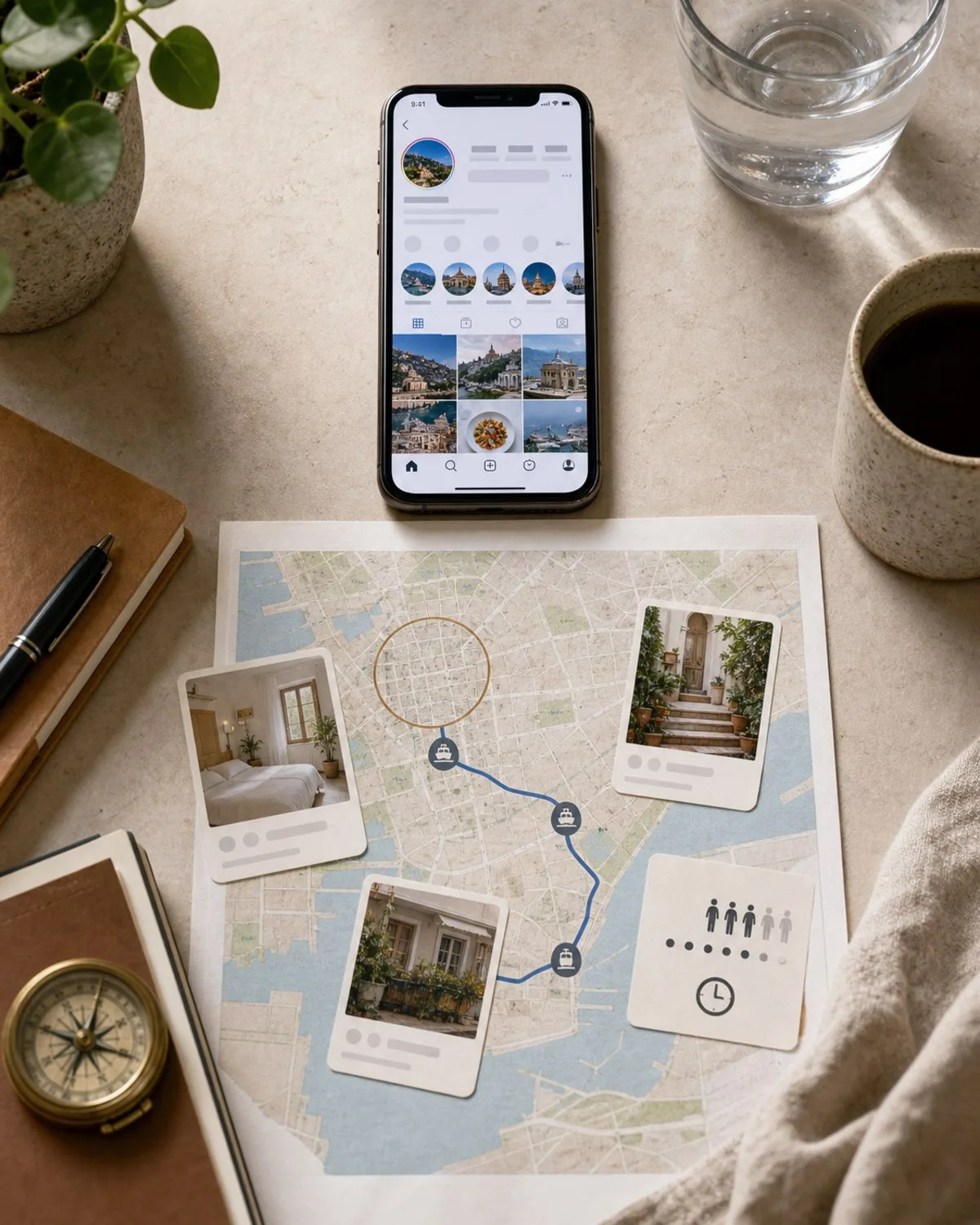
Social media now sets trip expectations before booking
Social media changed travel by collapsing inspiration and expectation-setting into the same screen. Before booking, people now absorb repeated public cues about what a trip will feel like: whether mornings start with a tram ride or a waterfront walk, whether dinner means a queue or a neighborhood table, whether the stay looks roomy or tight, whether the route reads as stroller-friendly, climb-heavy, slow, or rushed. Those cues do not need to be explicit to influence a decision. Repetition does the work.
This is where public travel content becomes powerful. A destination starts to feel known before the traveler has verified anything important. If the same account keeps showing compact hotel rooms, windy ferry decks, early bakery stops, and uphill evening returns, the viewer begins to picture a trip with a particular pace and effort level. If another account shows only wide scenic frames and clean cafe tables, the same city may feel softer, easier, and more curated than it really is.
The gap between legibility and truth matters. A 2025 Scientific Reports study of five Chinese heritage sites found that 78.3% of surveyed tourists relied on social media information for itinerary planning, while 67.4% said they would adjust visit timing based on real-time crowd information. That is a narrow context, not a global law. It is still useful because it shows how quickly public content can move from mood into timetable logic. Once that happens, expectation-setting stops being cosmetic and starts shaping the trip itself.
Why repetition beats one beautiful post
A single beautiful post can trigger desire. Repetition is what turns desire into a planning aid. Viewers trust patterns long before they say they do. If they keep seeing the same harbor crossing, the same compact breakfast setup, the same late-afternoon queue, or the same neighborhood walk appear across several posts, the trip starts to feel repeatable. The content no longer reads like one lucky moment. It reads like a route with a rhythm.
That is why recurring detail matters more than one polished frame. A single sunset image can sell atmosphere. A run of posts that keeps showing ferry timing, room scale, transit friction, and weather shifts gives the traveler something more valuable: a usable mental itinerary. The destination feels less like fantasy and more like a scenario they could borrow.
That is also why polish can become misleading when it hides the repeating conditions that actually define the trip. If the post sequence edits out the stairs, the queues, the noise, or the awkward transfer, the audience inherits the mood without the cost. The same problem sits behind creating authentic travel content in an over-filtered world: the issue is not beauty on its own, but beauty detached from the pattern that makes the trip real.
Virality changed what gets copied, crowded, and misunderstood
Virality changed travel by making routes more copyable, not just destinations more visible. The more a post supplies atmosphere plus route clues, the more it behaves like directions. A scenic cove, museum line, market lane, or sunrise viewpoint can move from "interesting place" to "easy itinerary fragment" once the public content stacks enough hints together. That stack might include location precision, caption timing, transport cues, repeated angles, and a clean sense of sequence.
The downside is not abstract. A viewer no longer needs to work very hard to reproduce the trip. That lowers the friction between discovery and imitation. It also widens the gap between what looks effortless on-screen and what the place can absorb in reality. A quiet location can seem calm because the frame was tight or the timing was unusual. A "hidden" stop can seem empty because the creator arrived early, skipped the queue, or cut the approach from the story. When the audience copies the visible result without the missing conditions, disappointment follows fast.
A 2019 Sustainability paper on Barcelona and Chinese tourists is useful here precisely because it stays cautious. The authors treated the link between social networks and overtourism as an exploratory question and discussed social platforms as possible accelerators of overcrowding rather than a single cause. That is the right boundary. Social media does not explain every crowd, every booking spike, or every tired neighborhood. It does make destinations easier to circulate, easier to imitate, and easier to misunderstand when the public cue stack looks complete.
Use the copyability test before calling a post harmless
The cleanest way to judge travel content is to ask how much effort it removes from repeating the trip. That is copyability. A post with high copyability does not just inspire. It quietly supplies enough public detail that a stranger can reproduce the stop, the timing, or the route with very little extra work.
Copyability rises when several choices point in the same direction. An exact location label helps. So does a caption that mentions the hour, the queue, the platform, the shortcut, or the side entrance. Repeated views of the same district or waterfront make the route easier to triangulate. A saved story collection can finish the job by turning scattered proof into an archive. None of those choices is automatically reckless. Together, they can convert mood into instructions.
That is why travel content should be reviewed as a system, not as one isolated post. A broad area label may be enough for a public venue but too precise for a fragile route once the rest of the profile supplies the missing clues. If your team is working through that tradeoff in detail, the impact of geotagging on hidden travel destinations is the adjacent problem to solve. The useful rule for this article is narrower: do not call a post harmless until you have checked how easily a cold visitor could copy what it shows.
Creators and travel brands now publish travel UX, not just pretty posts
For creators and small travel brands, every public detail now does travel work. Audiences are not only borrowing destination ideas. They are borrowing trip logic. A bio can promise family pace, design focus, food-first planning, or low-friction weekends. A saved story row can show whether the account archives transport, rooms, costs, or only the best visuals. Captions can either explain tradeoffs honestly or leave the hardest parts off-stage. Location choices can either keep the post atmospheric or make it feel ready to duplicate.
That means account structure now behaves like lightweight travel UX. Public content helps strangers decide what kind of trip the account is actually useful for. If the profile keeps showing calm waterfront mornings, short transfer days, and exact neighborhood context, the audience learns to expect a certain kind of trip. If the profile swings between luxury pools, budget ferries, long hikes, and tight city breaks without explanation, the account may still be attractive, but it is less legible.
The job is not to strip the fun out of travel posting. The job is to make the travel promise readable without pretending the public surface can answer everything. Publish so a stranger can tell whether the trip is slow or fast, polished or practical, expensive or moderate, route-heavy or open-ended. Then keep the limits honest. That is how public travel content stays useful without masquerading as complete truth.
A practical verification workflow for readers and teams
The smartest way to use social travel content is to separate discovery from verification. Public content is strong at helping you notice a place, imagine a pace, and decide what deserves a closer look. It is weak at confirming what is true today. Even fresh-looking posts can hide outdated hours, weather shifts, seasonal closures, transit disruption, or access rules that changed after the camera moved on.
Use the sequence instead of fighting it. Let public content narrow the field. Then verify the trip with sources designed for logistics, not mood. Official attraction pages, transport sites, maps, reservation systems, opening-hour pages, and recent local reviews still do the heavy lifting when money, access, and timing are on the line. That is also where teams should check whether a post that feels clean and inspiring is about to over-promise.
Verification workflow
- use public travel content to spot the place, the pace, and the part of the trip worth checking
- list the details that looked actionable: route difficulty, queue timing, room scale, transit burden, opening hours, or crowd level
- verify those details on official sites, maps, transport pages, reservation systems, and recent direct reviews
- keep the plan only if the verified logistics still match your budget, mobility needs, risk tolerance, and time window
This workflow is not pessimistic. It is efficient. A post can tell you what to inspect next. It still cannot tell you whether the trip works for you today.
Read travel content like evidence, not a verdict
Social media changed travel forever because public cues now shape trip judgment long before the booking page does. That makes travel content genuinely useful. It can show style, sequence, effort, and a rough sense of what the destination rewards. It can also make a place feel solved when the most important checks still have not happened.
The durable shift is not just more inspiration. It is earlier legibility. Travelers now arrive at planning with a stronger mental version of the trip already installed, and creators publish into that reality whether they intend to or not. Treat public travel content as evidence to investigate, not a verdict on what the trip will be.
FAQ
Does social media replace travel guides or booking research?
No. It often moves discovery and expectation-setting earlier in the trip-planning process, but logistics still need direct confirmation. Public travel content can help you choose what to inspect next. It cannot replace official opening hours, access rules, transport details, pricing, or current conditions.
Why do viral travel spots disappoint in person?
Viral posts usually scale atmosphere faster than context. A tight frame can hide the queue, the weather, the climb, or the transport burden that shaped the original visit. When viewers copy the visible mood without the missing conditions, the trip can feel more crowded, more awkward, or less special than expected.
Can public travel content prove safety or accessibility?
No. Public posts can show clues, but they do not confirm the current state of stairs, surfaces, closures, staffing, crowd control, or emergency context. Use them to spot questions, not to close them. Safety and accessibility need current, direct sources before they become planning assumptions.
What should creators change if they want to publish more responsibly?
Make the travel promise legible, keep captions honest about effort and tradeoffs, and use location precision deliberately. The goal is not to drain the post of energy. The goal is to help viewers understand what kind of trip they are seeing without quietly turning mood into misleading instructions.
Read next
Continue with adjacent articles that support the same public-viewing workflow.
guides
How Travel Creators Are Changing the Way We Explore the World
See how travel creators shape destination discovery through bios, repeatable post patterns, captions, highlights, geotags, and a quick usefulness audit.
discoveries
Why Local Travel Content Is Outperforming Luxury Destinations
Identify the cues that make local travel content more useful than luxury mood shots, with a simple audit for bios, highlights, captions, and trip logic.
discoveries
The Rise of Virtual Travel Communities
See how virtual travel communities become legible through recurring destinations, highlights, collaborations, comments, and location choices.